

In my adventures, I was cast to be in a short film about time traveling while wandering through an old home. The home was an old manor home in Rennes, Bretagne, France that was a large family home. The state in which we arrived was that the elders of the family, who were the caretakers, had recently passed, and the family members were coming by to collect the family heirlooms that they wanted. So, not quite an abandoned home, but not quite inhabited, but sadly in need of repair as the elders struggled to keep up with the maintenance of such an old home. An examination into entropy. The director found the home and wanted to use it as the setting, as at the time everywhere was filled with piles upon piles of antiques that had been pulled out for the family members to come and get. Sadly, as we approached the days of shooting, the family members kept showing up unannounced from far away to collect things and the piles slowly shrunk.

The piles of goods on the first day I got to tour. The director was upset that it has shrunk to this size.
The room where most of the dishes and antiques were piled up was my favorite room in the house. It was painted in one of those beautiful shades of green that the French use. Like a faded sage trimmed in gold, being light from the golden light of the wall sconces. It was probably the dining room, but it could also have been a salon.


What was interesting was that it had a connection to a room that mirrored it, with a fireplace between with glass above that looked like it should have been a mirror. Like looking into a mirror that left you looking for where your reflection is missing. The chimney being a bit of a mystery on where it goes. Perhaps it took a side of the opening. I liked how on either side of the fireplace they had installed radiators as a means of keeping that point as being the heat-generation portion of the room.

Through the “mirror” we see the rear of the fireplace. This reflected room is a lot less decorated and facing north doesn’t get a lot of direct natural light except through the “mirror”. In the shirt film, this room took on the character of a small chapel as it was filled with candles.

By the time it came to shoot the film, the crew used a smoke machine to fill the room, and the sunlight filtering in through the closed exterior shutters made a beautiful effect. It’s a shame that exterior shutters seem to have fallen out of style, as their ability to block sunlight from heating up a space is a great passive technology. Well, at least in the US. The Europeans seem to have evolved exterior shutters into these things that roll up into the window frame. As I tour all these older buildings, it is interesting to note that windows used to have a series of treatments with exterior shutters, interior shutters, and a series of layers of curtains. These ranged from lace to heavy blackout curtains. The act of keeping or repelling heat and/or light seemed to be much more of an active dance back in the day.
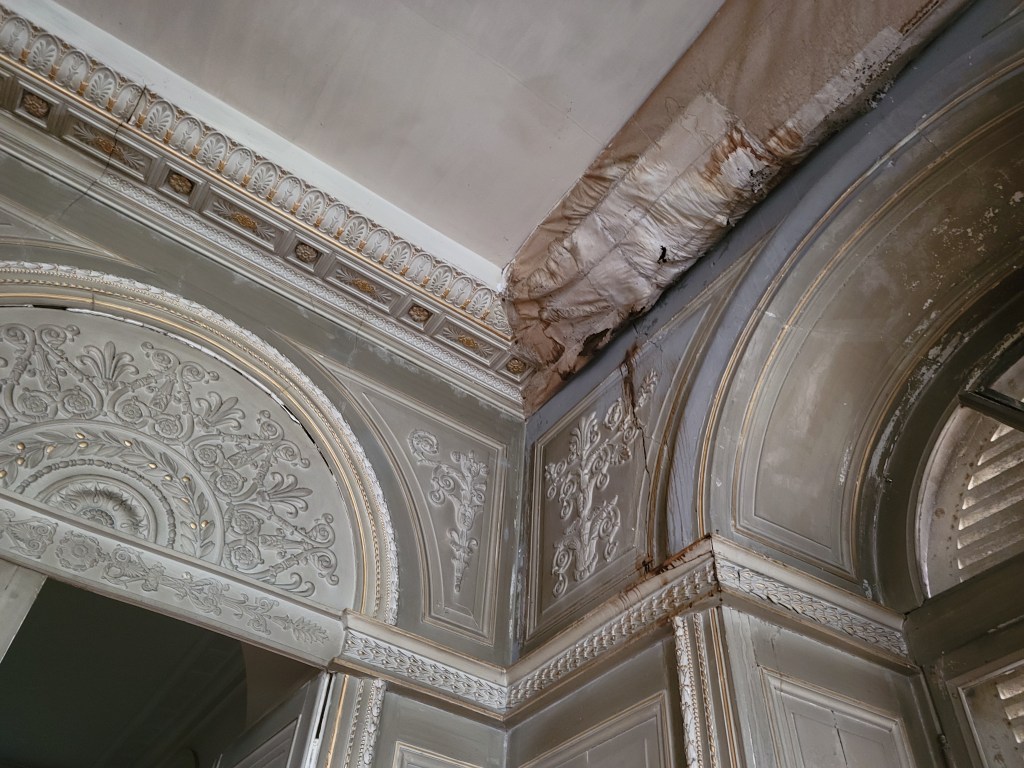
Sadly, in the green room there was a beautiful ornate moulding decoration wrapping around the room where the ceiling met the wall that was missing in sections. To fill the missing gap, paper had been hung to mimic the form, but I noticed in sections where the paper had drooped that behind it was nothing. Another element of the home’s entropy.
Continuing through the ground-floor, there were more large rooms. Perhaps salons, or dining rooms, or some other function, they had since been rearranged to hold generations worth of items pulled from their storage locations.

In watching the family heirlooms in this house slowly dissipate as different members of the large family arrived to take what they wanted, it reminds me of those places in our past that we can’t return to but hold such a strong presence within us. Like the family home that is sold or those places we lived as students. The place itself continues to live on and provide further memories for others (part of me feels lucky that I’ve never had a former home demolished yet) but one’s personal attachment disappears into only one’s memory.

Painted wallpaper is installed with decorative wood details covering the edges. I would imagine that it was much easier for installation to not worry about perfect edges.


You know you’re in Bretagne when the chandelier crystals are ermine spots.


And a small room right off the entrance hall and main staircase. I’d be curious as to its original intent, but the last residents of the home used it as a small TV and reading nook. I bet it was a lot easier to keep warm than any of the other much larger rooms.

Greetings from the entrance foyer.
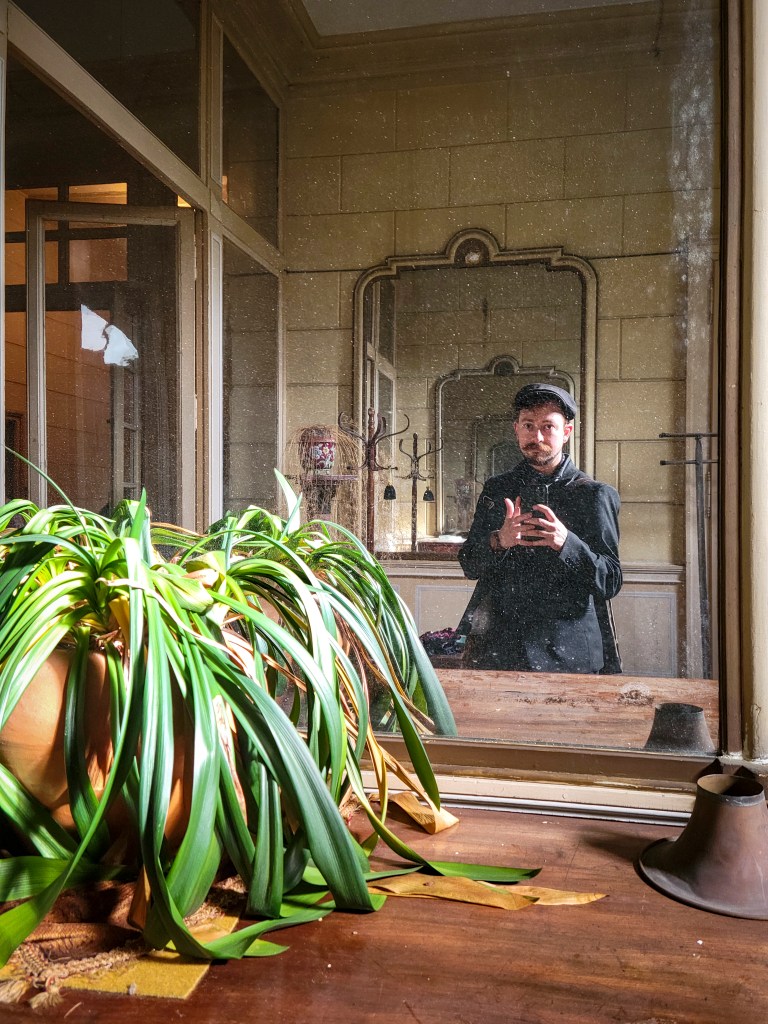
The home has a lovely oval, spiraling staircase. I’d describe it perhaps as grand-ish. The front entrance to the home lines up perfectly with the rear entrance, creating two foyers to look at one another, with the reflected rooms to one side and the other rooms wrapped around a small hall and staircase.


It is illuminated by a skylight above, stretching out over the oval.

And part-way up between landings, there is a hidden closet with a toilet.

Classic plumbing.
The first floor was a collection of large bedrooms, or perhaps sitting rooms, or perhaps studies.

Since closets aren’t really a common thing in France, the rooms have armoires to hold one’s clothes. The hallway was interesting, in that it was lined with cabinets and storage for things like linens.


I liked the addition of the glass plates to protect the door. While not as hygienic as more commonly used brass plates, they seemed to emphasize the door over the hardware.
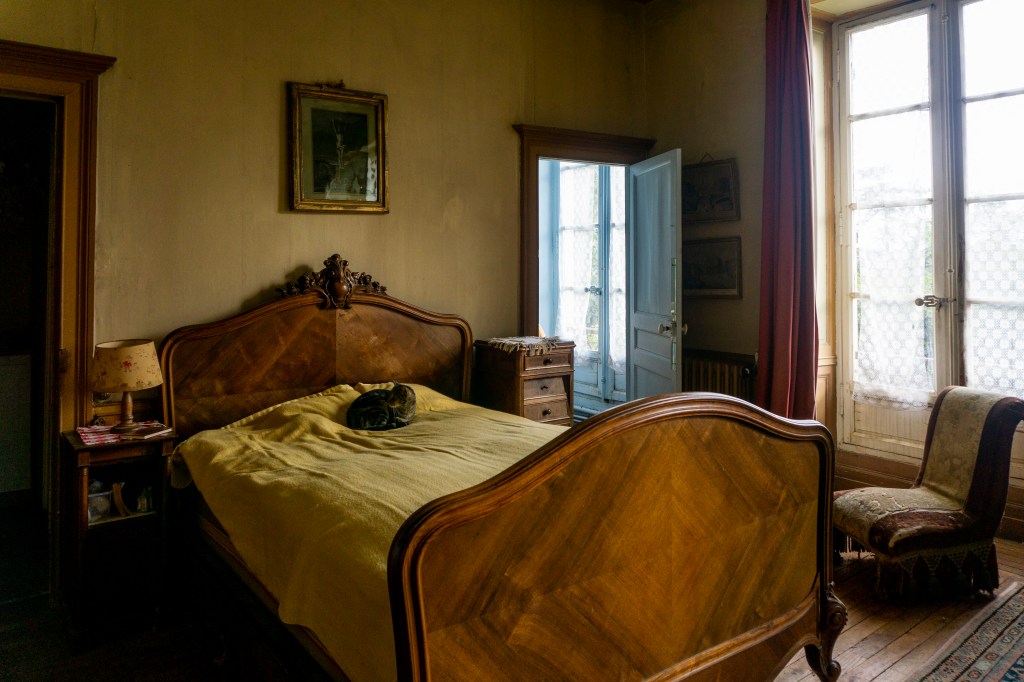
At one point, we came across a cat that had broken in and found the biggest bed to take a nap on in the middle of the day. It seemed disappointed that this whole house wasn’t, in fact, its house to be alone in.


I love the design of these tall, skinny windows. The way they fill a space with light in contrast to the dark walls next to them. The way they balance the long rectangular panes in the center with the smaller squares at the top. Like a head on top of a torso. I like when there is an inherent feeling of balance to the mullions of a window when it isn’t just a single field of glass.


The bookcases were not original with the building, as on the wall of a neighboring room one can find a door that would open to the backside of the bookcases.

A writing desk. The ink well reminding me of a youth partially spent in the Great Plains.


The lamp of the library, while not uncommon in France, I thought was interesting for its ability to be raised or lowered as needed.

Arriving upstairs, the rooms shrunk to small bedrooms with beds tucked under the slope of the roof above. At one point we found some photos of the family standing in front of the house. It appeared that they had at least a dozen children, so one could imagine that at one point this house was completely full, with all the rooms being used. The center of this floor was illuminated by a series of skylights.

It looked like there might have been more through this center skylight, as I could see there were little cabinet doors, but I have no idea how one would have gotten to them to open them. This might have been for the best because there was a rumor of artillery shells in the attic that none of us could find.

The center of the hallway included a glass-block floor that helped filter the natural light down to the floor below. In the film, they used this to give a strong, filtered light from above as they set up their lights to point directly at it while I walked the hallway below.

The entropic state of the home gave me a bit of worry about the glass floor, but it never seemed to budge as we walked across it over and over.

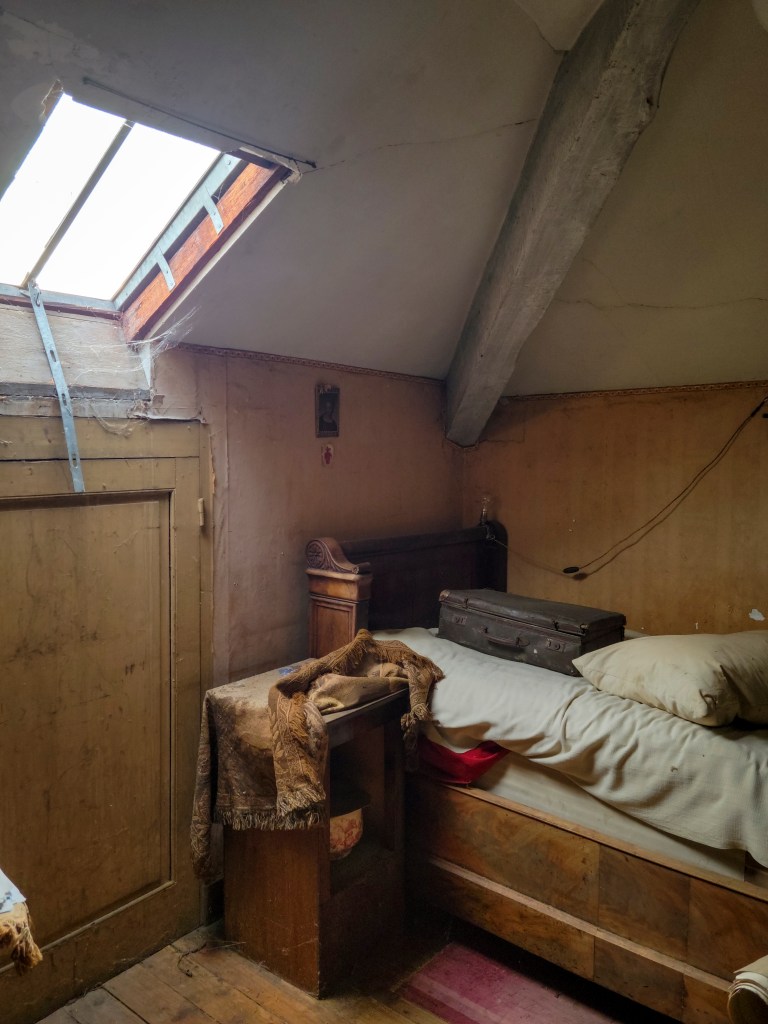
Dealing with the slope of the roof, some rooms of this upper floor installed a wall and then a cabinet door. This converted the dead space that was too tight to inhabit into storage space. This particular bedroom felt more like a studio apartment for a student working on their studies.

The books in the home seemed to skew heavily religious and towards the right in politics, but perhaps that was just something that was a product of its time. Although we did find a copy of Mein Kampf at one point (which gets stranger as I delve deeper into this home).
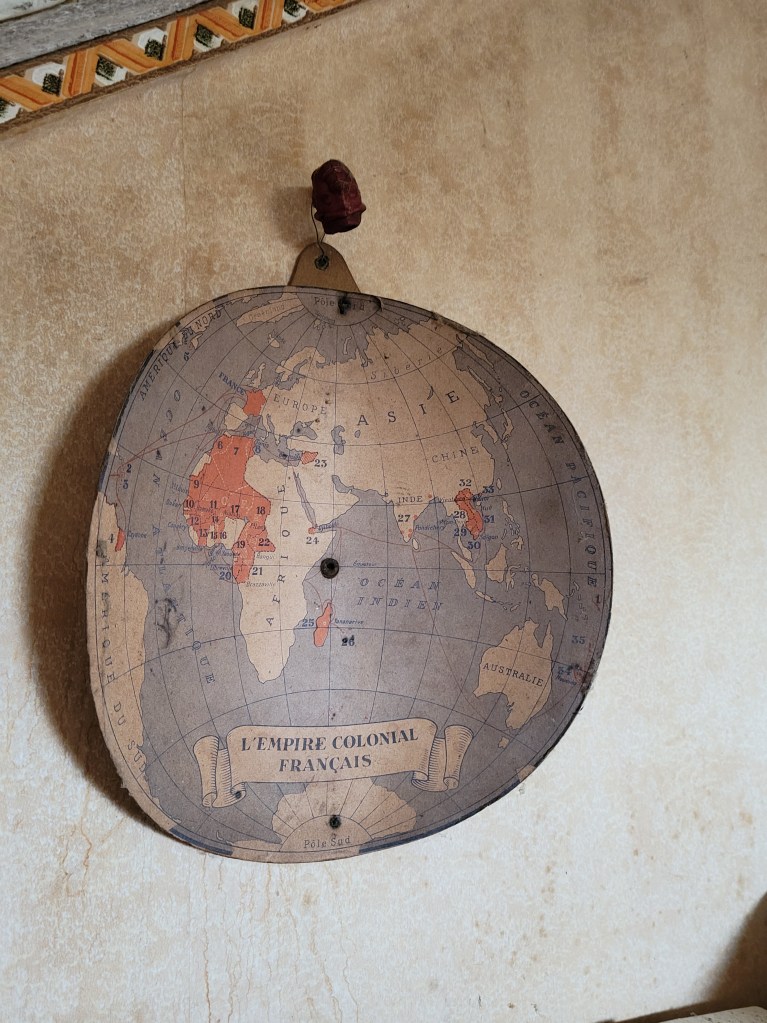
Definitely details that were of their time.

Also on this floor there appeared to be a servant’s apartment. There is a door to separate one end of the floor off and had its own bedroom, kitchenette, and lavatory.


Speaking of those who run a home, jumping down to the basement was where the original kitchen was. Stone and beam construction exposed, to call it finished would be an exaggeration. Some floors had tile. Others did not. There was a wine room (with no light, so I couldn’t get a photo) that seemed to mimic the library upstairs, with metal racks closing in on the room to hold rows and rows of bottles. The bottles had all left, but metal ID tags still hung from certain spots giving dates and information about the missing bottles.

The old oven sits dusty.

The stone kitchen sink.

I don’t believe that I ever figure out what that cylinder was. Perhaps a covered old well ?


And in a moment of palimpsest from a time past : German writing on one of the walls from during the Occupation. Meaning that this home was used in some capacity by the Germans.
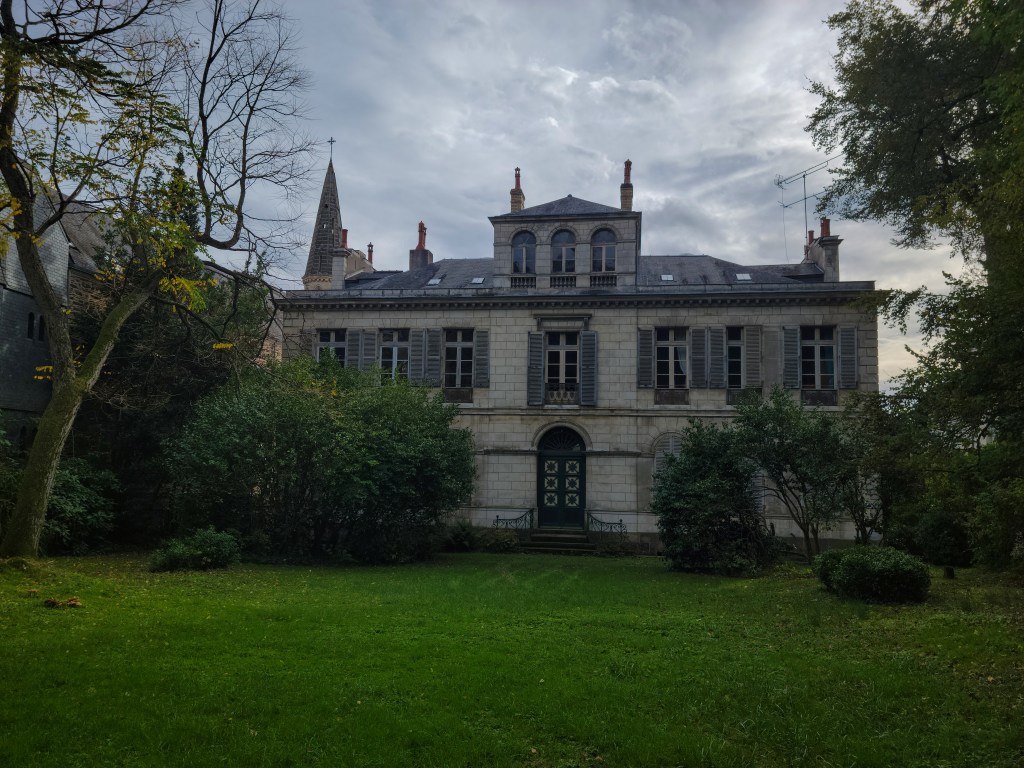
Moving outside, the grounds open up to a large backyard. Trees and bushes line the exterior to a green field of grass in the center.
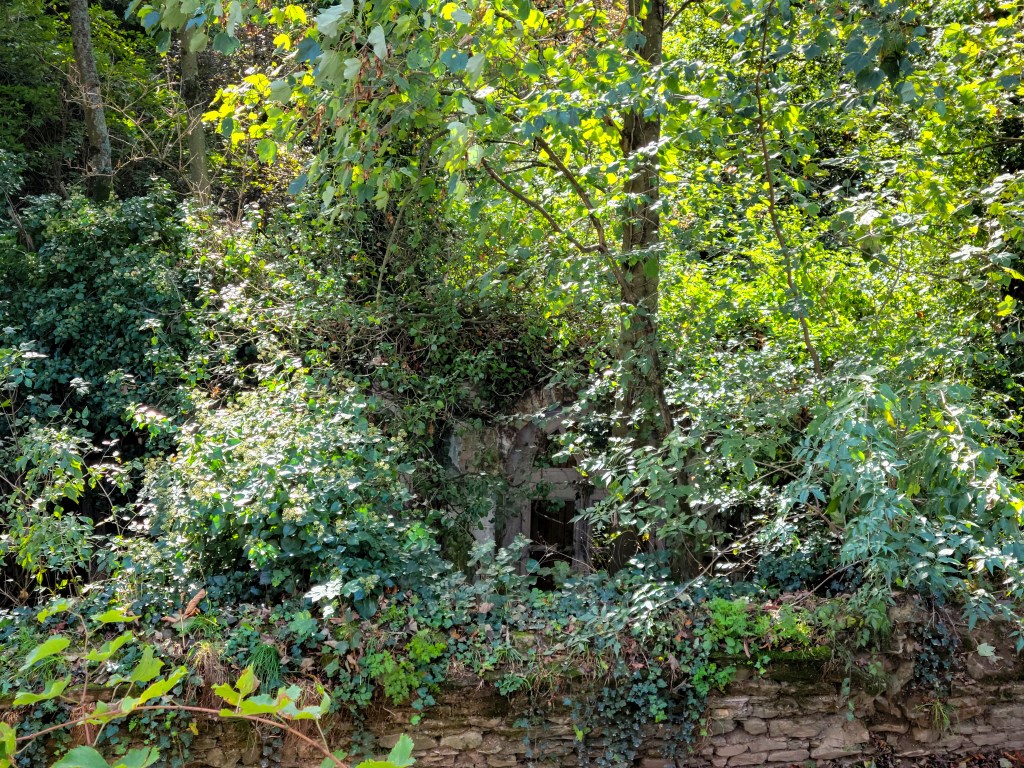
Tucked away in the far back of the lot was an out building is being consumed by nature.


While the front of the lot holds a carriage house (turned perhaps caretaker) home also falling to the effects of entropy.
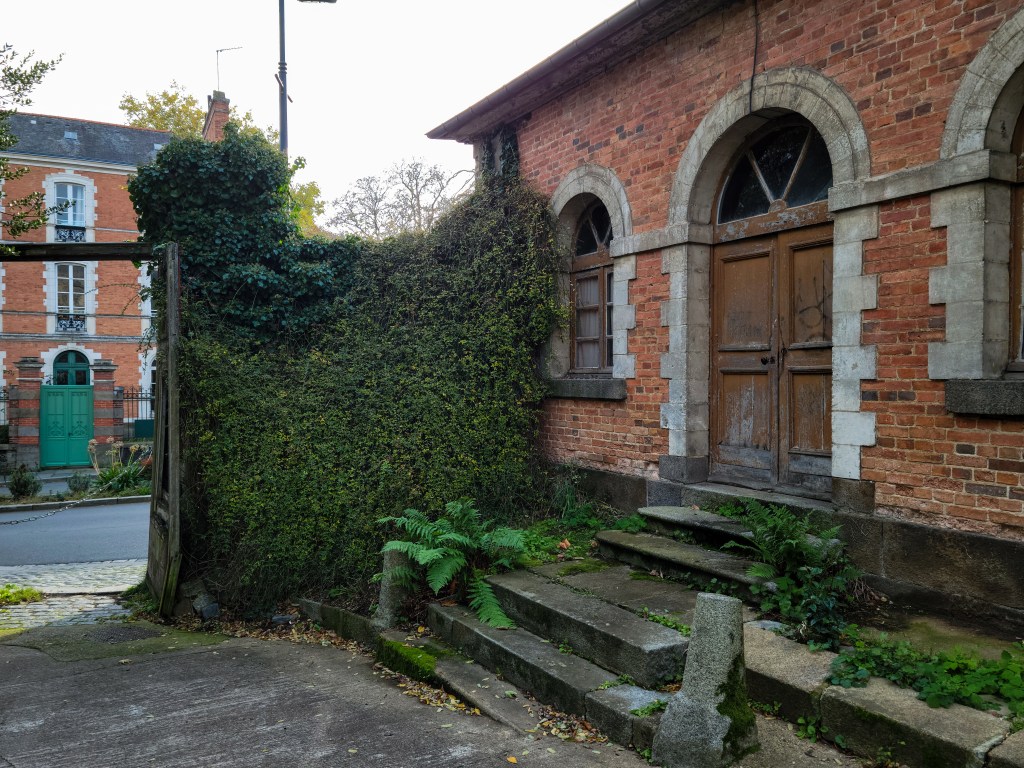
The front has a couple of rose bed on either side of the entrance and vines directed to climb along the exterior. Thick vines show that they have been directed and held back for ages, although they have started to fight beyond their restrictions.

Bonus detail is this drawing on the side of the building showing what the exterior lights used to look like before they were removed.

And thus ends the tour. Merci. A la prochaine.
3 responses to “A manor home in Bretagne.”
-
Very nice! A lovely your mon ami! Merci Beauvoir!!
LikeLike
-

Oh my goodness, what a beautiful house. And it will sell for around $200,000. The taxes and upkeep for those grand country homes is more than the elders can afford. The round thing in the basement was probably the cistern for water. It looks like it hasn’t been touched for years. Lucky you, great photos.
LikeLike
-
Thank you ! I had such a fun time wandering around and searching for hidden treasures. It’s right in the middle of town, so I can imagine that if the family does put it on the market, that it could get quite a bit of interest. A cistern makes perfect sense ! I wish I had more experience with them, so I could have figured out their rain catchment system. It seems like a perfect old technology to reassess for building sustainability measures.
LikeLike
-


 High Contrast Grey.
Leave a reply to Carol mask wearer (@energycarol) Cancel reply