
Times and moods change, but sometimes things that might get lost to the entropy of time find the ability to be saved. Opening in 1901, George Fouquet’s jewelry store on 6 Rue Royale was situated opposite the famous restaurant Maxim’s which had just been given its famous Art Nouveau interior in 1899 for the upcoming Exposition Universelle. (The Paris World’s Fair that saw the debut of the Paris Métro, the exhibition spaces of the Grand Palais and the Petit Palais, as well as the Gare d’Orsay that would later become the Musée d’Orsay. The Eiffel Tower was painted so that the base transitioned from an orange to yellow at the top and was used as an entrance space to the Exposition Universelle after it had had its debut at its own Exposition Universelle in 1889.) Fouquet enlisted the famous Art Nouveau artist Alphonse Mucha to design his shop after they had already previously collaborated on jewelry designs. Mucha designed everything in the shop down to the smallest detail. Thankfully, after Art Nouveau waned in popularity the components of this shop were donated by Fouquet to a decorative arts museum in Paris and was saved from being lost to only being some sketches and black and white photos. The shop is now reassembled for display at the Musée Carnavalet, which is a museum in Paris telling the history of Paris.
Alphonse Mucha was born in what is now the Czech Republic and in 1888, in his mid-20s, he moved to Paris. Mucha had attracted the attention of a benefactor who was paying for him to attend art schools in Europe. Although, after a year in Paris attending art schools, his benefactor decided that his schooling should end and Mucha was forced to find work. Through connections he made with the Slavic community in Paris upon arriving he was able to find housing as well as a job in illustration. It was his theater posters of Sarah Bernhardt that helped launch his career, with these posters still being reproduced to this day for their artistic quality as quintessential Art Nouveau. Starting around 1898, Mucha and Fouquet began a partnership in which Mucha would design jewelry. This included a snake bracelet worn by Sarah Bernhardt in his poster Médée.

The Entrance to the shop.
In the entrance to the shop, we find the framework of a classic Parisian shop façade, but Art Nouveau elements are beginning to encroach. The beautiful, stained wood form is being accented by metal taking the form of organic leaves. Celebrating the feminine form, a relief sculpture of a woman made of bronze is coming out of the wall between the two doors with jewelry held high in her hands. Continuing the feminine, there are stained-glass portraits of women above the doors wearing fantastical Art Nouveau crowns and headpieces. Noting that this façade would have been on a Parisian commercial street, this Art Nouveau detailing still expressed the Parisian storefront form to maintain the architectural language of the street while also standing out to the pedestrians.

Inside the shop.
Where the exterior of the shop showed elements of Art Nouveau details spilling through the inside of the shop has broken past the framework of Parisian architecture to embrace the wide breadth of Art Nouveau style. The organic forms and details seen in the posters of Mucha have found their way onto the walls, ceiling, and floors of the shop as well as evolving into sculpture. The room is artificially illuminated from above by a chandelier of flowers bundled and hung upside down as though to dry. Each flower of the chandelier is opaque glass to glow white from the electric bulb placed in front of it. The jewelry is shown in half-dome organic forms that appear to grow out of the wall. These unique display cases are beautiful forms that feel both ancient and futuristic. (Perhaps it is, in part, because utopian sci-fi media that has expresses a symbiosis with nature has adopted the Art Nouveau imagery.) The tapering half-column pilasters feel like a cross between a streetlamp and a tree as they help break up the walls into sections. They also visually connect with the two wrapping layers of Art Nouveau wallpaper in the double frieze as perhaps a canopy line of leaves and flowers.

Behind the main counter.
Notably, one focus is on the two metal peacocks with glowing ornamental glass ocelli on their feathers. They are behind the main counter, with one spreading its feathers out in front of a round stained-glass window that halos the bird. The other peacock has taken to jumping up to explore the room’s moulding. The stained-glass at the rear of the room illuminates the space with a glowing painted imagery of nature.

Stained-glass detail.
The stained-glass looks less like the classic forms of stained-glass found in churches and cathedrals and instead as if Mucha’s printed posters had found a means by which to glow. The bright colors being other-worldly. The lack of using lead to separate the sections but instead using painted black on the glass means that even the dark areas glow with light. Mucha lets the fields of color fluctuate in their irregularity while the line work provides form and an understanding of subject. Much like one would find with Japanese woodblock prints. We don’t see Mucha’s subtle lines to provide shadow and depth, but instead a range in concentration of color provides the gradient of shape.

The fireplace.
This fireplace is actually a recreation after the original was lost. (Same with the mosaic flooring.) The fireplace has its own section of the wall within the shop where it is flanked on either side by murals and a mirror directly behind. The murals depict scenes of under the sea on the left and within the flowers on the right. Two bouquets of flowers mounted to the wall separate the murals from the mirror. These bouquets of flowers are much like the one above (as seen in the mirror) in that each of the flowers is an electric light being reflected by opalescent white glass petals. The mirror behind reflects the light into the room creating a level of illumination that would have been unusual for this time period. The large mirror, while partially blocked by the fireplace, would also function in a way to make the small Parisian shop “feel” larger as the mirror offers a glimpse to a perceived room beyond. With the fireplace blocking a person from seeing their own reflection, this becomes about the otherworldly nature of mirrors that allows a glimpse to another space. The placement of the mirror could have also been seen as a means of reflecting the heat of the fireplace back into the room. Assuming that this fireplace wasn’t designed just for people to place burning wood onto the marble floor reserved for the fireplace, there would probably have been a removable coal burning contraption inserted into the opening. The form of this fireplace is organic but constructed out of a variety of different materials. It looks like it could be a carved trunk of some unknown tree. A mother tree stump that has been cut. but is giving birth to new growth which would be shown with the vase at the top. This vase would hopefully be filled with fresh flowers every day when the shop was functioning. The opening of the fireplace allows us a brief glimpse under the hardened shell to find that it is filled with flame and glowing embers. An image of rebirth through the use of flame. Forest fires giving birth to fields of flowers. This is all my analysis of just looking at it though, so who knows what Mucha’s true idea behind it was. The opening uses a crescent form that is found in a lot of Mucha’s work frequently in the form of crowns or halos paired with his figures. What is interesting about his crescents is that it seems to be where geometry pairs with the organic form. These crescents are usually comprised of two circles offset from the smaller circle using a dropped center point. Which can be seen diagrammed out on the crescent with the oval forms.

Detail look at the top of the fireplace.
Taking a closer look and focusing in on the top of the fireplace is one of those details that I find are frequently lost in photographs : the top is covered in tooled leather mounted upon a wooden form. The use of leather would mean that the fireplace would age and show marks from its use. In this detail shot, one can see how even in a protected museum setting there are the little scratches and stains of life. The use of leather would also mean that the maintenance of the fireplace would include massaging it with oils to preserve it. The fireplace has become a “living” aging organism.


Details looking at the painted mural under the sea.
The murals on the walls at first look appear to be prints with their black outlines tracing forms as is found with many of Mucha’s posters, but the reality seems to show that they are actually paintings upon canvas. Light washes of painted color that maintains the texture of the canvas behind. Except for the outline of the water bubbles where the thicker white paint protrudes slightly. Seeing these not as murals painted upon the wall, but as paintings mounted upon the wall it is interesting to note how Mucha’s mounting of them with architectural details of pilasters, moulding, and mirrors changes their perception as paintings mounted in a frame on a wall to that of décor. But they are paintings. They are individual works of art painted by Mucha and not intended for mass production. Which I believe opens up a dialogue that Art Nouveau (as well as Arts and Crafts and other art movements at this time period) was having about art in our everyday spaces, but not as consumed commodities as much as objects for living. A life without art is not as fulfilling so the question is posed as to why the art world creates expensive objects that caters only to the rich. The irony (or perhaps frustration with the reality of paying artists a fair wage for their labour) to have this conversation in a luxury jewelry shop. Although perhaps we could use this as a means of again looking at art as everyday objects, such as jewelry, where it is the act of using them that provides our life with beauty. The movements that struggled with this dilemma still ring true to this day and the irony is probably not completely lost when cheap mass-produced replicas of Mucha’s work finds its way into the hands of the masses at affordable rates, but only because the industrialized machine that it was hoping to combat has been used to create these facsimiles. In one of the last courses I took to finish my Fine Arts degree the prof shared a life lesson that to be a working artist means that you will never make the income that fits with the amount of work put into an art piece. To be a working artist is a labour of love.

A woman looks over the customers.
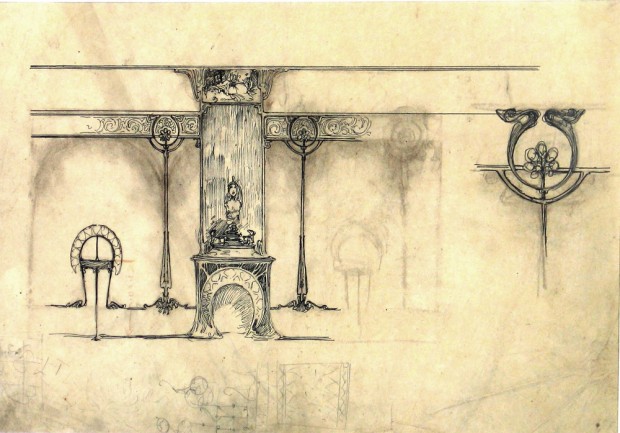
Returning to the room, opposite the main counter at the front of the shop is another mirror to reflect the electric light further around the room making this an incredibly well-lit space, even on dreary Parisian days. In front of the mirror is another small counter with a bust of a woman’s head looming above with her head seeming to appear out of the smokey waves of her cascading hair. When one looks at this specific bust at the right angle, she aligns perfectly with the ceiling becoming her halo. In looking at Mucha’s sketches of this space, it seems as though he moved the concluding sculptures around as he found fit.
Sadly, Mucha’s design for the store only lasted until 1923 when the shop was remodeled with something more fitting for the new time period. Today the spot of 6 Rue Royale is one of Arthus Bertrand’s three Parisian jewelry shops. Apparently, this space is destined to have a lasting connection with jewelry.
BONUS :
An in-depth look at Mucha’s jewelry collaboration with Fouquet : https://art.bid/NPsi
A fan-boy video I took spinnning around the room : https://flic.kr/p/2oDpWKL
 High Contrast Grey.
Leave a comment